
Winter Table Tennis Season in India (2026-27): Ball Choice, Bat Care and Club Prep
Winter is when Indian table tennis halls come alive. Here is the pre-season check: ball grades, cold-weather rubber behaviour and post-monsoon bat care.
Winter table tennis season in India (2026-27): ball choice, bat care and club prep
Winter is table tennis season in India, and the reason is simple: the halls stop being saunas. From late October through February, club play across north and central India gets faster, longer and far better attended. It is also the stretch of the year when equipment behaves differently — rubbers go duller in the cold, blades that survived the monsoon start showing warping, and the ball you bought in June may not be the ball you want in December.
Here is a practical pre-season check for Indian club players.
Cold weather and table tennis rubber: what actually changes
Rubber is temperature-sensitive. In cold conditions the topsheet and sponge become temporarily less elastic, which shows up as a slightly deader feel, less grip on the first few shots and a ball that sits up more than you expect. It is not damage — it reverses as the rubber warms — but it does mean the first ten minutes of a winter session are genuinely different from the last ten.
Two practical responses. First, warm up longer than you would in summer; the equipment needs it as much as you do. Second, keep the bat in its case rather than on a cold table between games, because a bat that stays near room temperature plays consistently.
Choosing table tennis balls: 3-star vs training balls
This is the question that comes up every pre-season, and the answer depends entirely on what the balls are for.
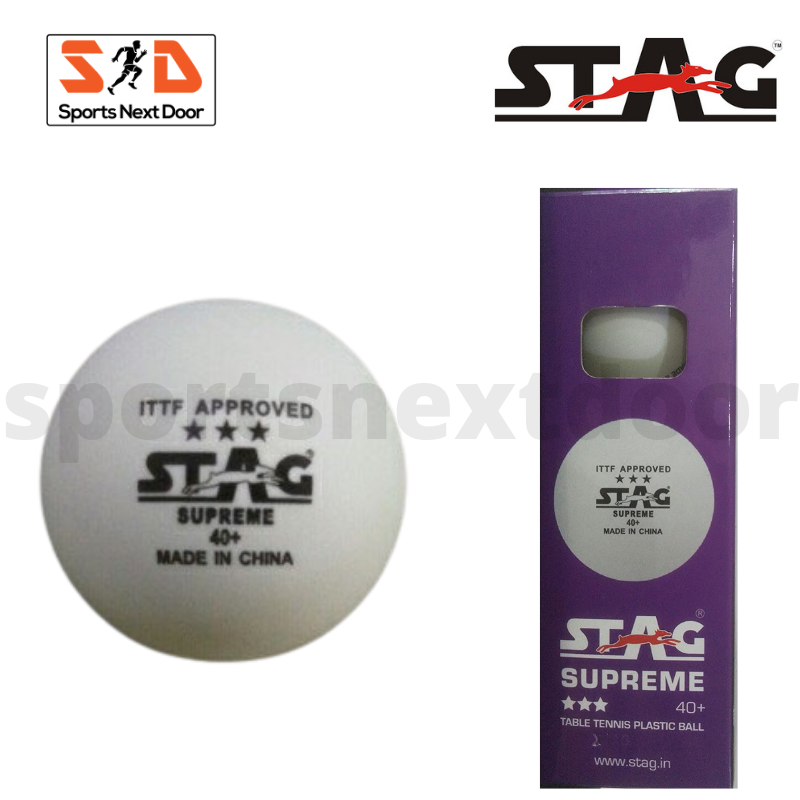
3-star balls are the competition grade. The wall thickness is more consistent, so the ball bounces true off the centre of the bat and does not wobble in flight. For matches and serious practice, this is what you want. The Stag Supreme Three Star Plastic Table Tennis Balls (Pack of 3) at ₹349 and the Yinhe H40+ 3-star ABS balls (pack of 6) at ₹299 are both sensible club-level choices.
Training and lower-star balls make sense when you are hitting volume rather than chasing precision — multiball drills, robot feeding, coaching sessions with juniors. Buying fifty 3-star balls for multiball is money burnt. The Stag 2 Star Orange TT Ball 40+ (Pack of 6) at ₹300 and the GKI Kung Fu 1 Star ABS 40+ ball at ₹137 cover that job. The Stiga Cup 40+ at ₹240 sits between the two.
One winter-specific note: orange balls are noticeably easier to track in the dim, low-angle light many Indian club halls have in December and January.
| Use case | Ball grade | Why |
|---|---|---|
| Matches and league | 3-star | True bounce, consistent flight |
| Serious two-player practice | 3-star | Your timing should train against match conditions |
| Multiball and robot drills | Training / 1–2 star | Volume matters more than precision; roughly half the cost |
| Junior coaching | Training | High loss rate, low precision requirement |
| Dim winter halls | Orange, any grade | Easier to track in poor light |
Post-monsoon bat care: the checks worth doing now
The monsoon is hard on table tennis equipment, and winter is when the damage shows.
- Check the blade edges for swelling. Wood that absorbed humidity can swell or warp. Never store a blade in a humid room, and if your kit lived in a cupboard through July, inspect it now.
- Clean the rubbers with water and a soft sponge only. Wipe the surface, keep water off the blade edge, and let it dry fully before putting the protective film back on.
- Replace protective film. It is cheap and it is the difference between a rubber lasting one season or two.
- Use a hard case if you travel to matches. Dents in the blade edge change how the bat plays and cannot be undone.
Done properly, a good blade lasts many years. Done badly, a monsoon can finish one.
If you are replacing a bat this season
For club members who use pre-assembled bats rather than custom blade-and-rubber setups, the winter restock is a good moment. The Stag Global 4 Star Table Tennis Bat (with cover) at ₹525 and the Stag Global Official Table Tennis Bat (with cover) at ₹975 cover recreational and improver levels. The 729 Very 7 Star Table Tennis Bat (1 bat, 2 balls, cover) at ₹3,839 is a step up for players who are not yet ready to assemble their own.
If you are thinking about a custom setup instead, start with our guide to blade ply construction.
A club pre-season checklist
- Inspect every blade for warping and edge damage
- Clean rubbers, replace protective film
- Stock 3-star balls for matches, training balls for multiball
- Switch to orange balls if hall lighting is poor
- Extend warm-ups by five minutes while halls are cold
- Check nets and posts for monsoon rust before the first league fixture
Shop the gear
- GKI Kung Fu 1 Star ABS 40+ Table Tennis Ball — ₹137
- Stiga Cup 40+ — ₹240
- Yinhe H40+ 3-Star ABS Table Tennis Balls (Pack of 6) — ₹299
- Stag 2 Star Orange TT Ball 40+ (Pack of 6) — ₹300
- Stag Supreme Three Star Plastic Table Tennis Balls (Pack of 3) — ₹349
- Stag Global 4 Star Table Tennis Bat (With Cover) — ₹525
- 729 Very 7 Star Table Tennis Bat — ₹3,839
Related reading
- How to Choose Table Tennis Balls: 40+ Poly and Star Ratings Explained
- Table Tennis Blade Ply Explained: 5-Ply vs 7-Ply vs Carbon (India)
- Table Tennis Rubber Thickness and Sponge Explained
Frequently asked questions
Should I use 3-star or training table tennis balls?
Use 3-star balls for matches and serious two-player practice, because more consistent wall thickness means a true bounce and no wobble in flight. Use training or lower-star balls for multiball, robot drills and junior coaching, where you are hitting volume and the balls cost roughly half as much.
Does cold weather affect table tennis rubber?
Yes, temporarily. In cold conditions the topsheet and sponge become less elastic, so the bat feels duller and grips less on the first few shots. It reverses as the rubber warms up, so extend your warm-up and keep the bat in its case between games rather than on a cold table.
How do I care for a table tennis blade after the monsoon?
Check the blade edges for swelling or warping from absorbed humidity, clean the rubbers with a soft damp sponge while keeping water off the blade edge, let everything dry fully, and replace the protective film. Store the bat in a hard case, never in a humid cupboard.


