
Treadmill Belt Size and Deck Width in India: How Much Running Room Do You Actually Need?
Motor power gets all the attention, but belt size is what decides whether a treadmill feels safe at speed. Here is how to pick deck width and length by your height and how you actually train.
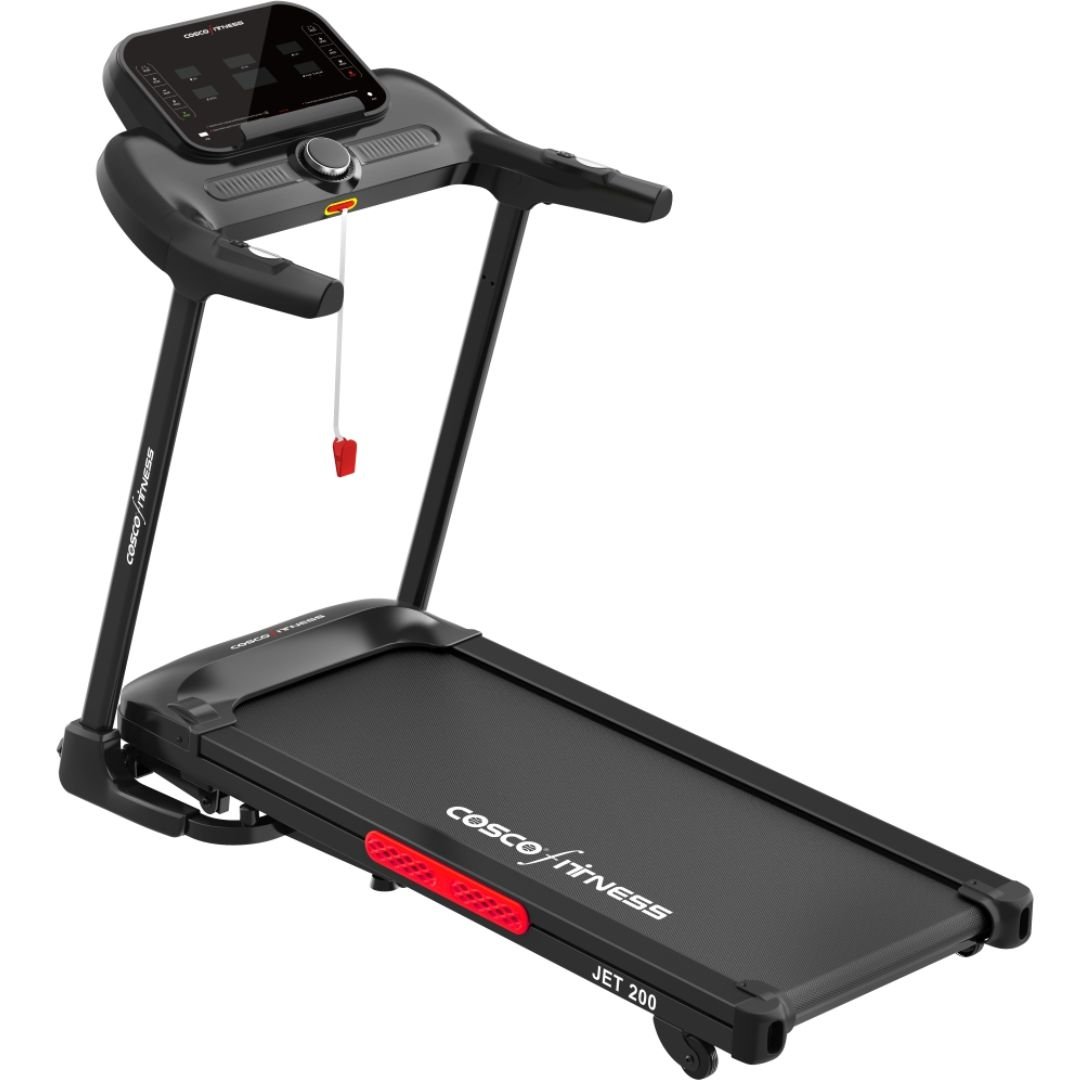
Treadmill belt size in India: the spec that matters more than motor HP
Treadmill belt size is the number most Indian buyers skip and most regret later. Showroom conversations revolve around motor horsepower, and the running belt — the strip you actually stand on — gets a passing mention. But belt dimensions decide whether you can run naturally at 12 km/h or whether you spend every session consciously keeping your feet in a narrow lane.
Two numbers define it: width (side to side) and length (front to back). Both are quoted in inches or centimetres in Indian spec sheets, usually as something like "44 x 16 inches". Wider gives you room for arm swing and a natural foot strike; longer gives you room for the stride that opens up as you speed up.
How much treadmill deck width do you need?
Width is about confidence. A narrow belt makes you run "small" — shoulders tight, arms tucked — which is both less comfortable and, at speed, less safe.
- Under 16 inches — walking pads and compact folding units. Fine for brisk walking and incline walking, cramped for running.
- 16–18 inches — the mainstream Indian home treadmill. Comfortable for jogging and steady running for most adults.
- 20 inches and above — gym and light-commercial territory. Noticeably roomier if you are broad-shouldered, over roughly 6 feet, or doing intervals.
If you share the machine with a taller family member, buy for the taller person. A wider belt is never a problem for a smaller user; a narrow one is always a problem for a larger one.
How much belt length do you need for your stride?
Length scales with speed, not just height. Your stride opens up dramatically between walking and running, and a belt that felt generous at 6 km/h can feel short at 11 km/h.
| How you will use it | Suggested belt length | Who it suits |
|---|---|---|
| Walking, incline walking | 45–48 inches | Most adults up to about 5'8" |
| Jogging and steady running | 50–55 inches | Most adults up to about 6'0" |
| Fast running, intervals, tall runners | 55–60 inches | Over 6'0", or anyone training above 14 km/h |
A quick self-test: walk on the machine in the showroom, then ask to take it to your realistic top speed. If your foot lands within a hand's width of the front roller or you feel yourself drifting back towards the rear, the deck is short for you.
What belt size you get at each budget in India
Deck size tracks price fairly predictably in the Indian market. At the entry end, the Cosco Treadmill GO 1.0 at ₹31,520 and the Cosco Treadmill Jet 100 at ₹34,999 are built around walking and light jogging — sensible for a first machine, tight if you plan to train for a half marathon indoors.
Step up and the deck grows. The Cosco Treadmill Jet 300 at ₹47,999 and the Viva T-146 Motorized Treadmill at ₹58,125 sit in the range where most adults can run properly rather than shuffle. Above that, machines like the Cosco Fitness AC 360 Treadmill at ₹70,999 bring gym-style deck dimensions and the AC motor that goes with them.
Deck thickness, cushioning and why they matter in Indian homes
Belt size gets you room; deck construction gets you comfort. A thicker MDF or phenolic deck flexes less, absorbs more impact and tends to last longer. Cheap thin decks transmit more of each footfall into the frame — which you feel in your shins and your neighbours hear through the floor.
Apartment living makes this a practical concern rather than a luxury one. A well-cushioned deck on a rubber mat is the difference between a 6 a.m. run and a complaint from the flat below. If your machine folds, check the belt size again in the folded position: some compact units achieve their small footprint by shortening the deck rather than the frame.
Belt care: the part that decides how long the deck lasts
A correctly sized belt still fails early if it is neglected. Three habits cover most of it: keep the belt centred and correctly tensioned, silicone-lubricate the deck at the interval your manual specifies, and keep dust and grit off the running surface. In humid coastal cities, wipe the deck down after sweaty sessions rather than letting salt sit on it.
Belt drift to one side is normal over time and is adjusted with the two rear roller bolts — quarter turns only, and always with the machine running slowly and no one on it.
Matching belt size to motor
A large deck paired with a small motor is a mismatched machine. Broadly: if you are buying a 55-inch-plus deck for genuine running, you want continuous-duty motor power to match, and that usually means stepping into AC-motor territory. Our guide to treadmill motor HP for home use in India covers how the two specs should line up.
Shop the gear
- Cosco Treadmill GO 1.0 — ₹31,520
- Cosco Treadmill Jet 100 — ₹34,999
- Cosco Treadmill Jet 300 — ₹47,999
- Viva T-146 Motorized Treadmill — ₹58,125
- Cosco Fitness AC 360 Treadmill — ₹70,999
Related reading
- Treadmill Motor HP Explained: 1.5 HP vs 2 HP vs 3 HP for Home Use (India)
- Best Treadmills for Home Use in India: A Practical Buying Guide
- Monsoon Treadmill Care: How to Prevent Rust, Belt and Motor Damage (India 2026)
Frequently asked questions
What treadmill belt size is best for running at home in India?
For genuine running rather than walking, look for a belt at least 18 inches wide and 50 to 55 inches long. Taller runners and anyone training above roughly 14 km/h are better served by 20 inches wide and 55 to 60 inches long, which is where gym-style and light-commercial machines sit.
Does a wider treadmill belt make the machine safer?
Yes, in practical terms. A wider belt lets you run with a natural arm swing and foot placement instead of consciously staying in a narrow lane, which reduces the chance of clipping the side rails at speed. It matters most for broader or taller users and for interval sessions.
How often should I lubricate a treadmill belt in India?
Follow the interval in your manual, which is typically every few months or after a set number of running hours. In dusty or humid Indian conditions, check more often: lift a corner of the belt and feel the deck. If it is dry to the touch rather than faintly slick, it is time for silicone lubricant.


